TESSERACT
An assistant that runs on your machine, remembers you across sessions, and asks, by default, before it writes to a file or runs a command.
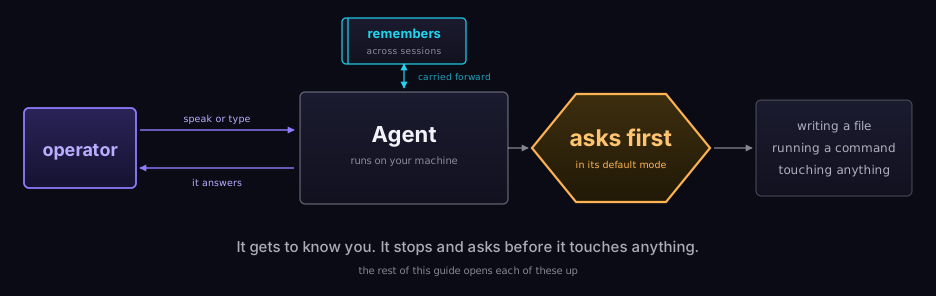
That drawing is the whole product in one line. The rest of this guide opens each part of it up.
Download it (Windows) · Read the source (AGPL-3.0)
Start here
- What it is — the idea, in a page.
- Install — getting it running.
- Setting up — keys, models, and where your things live.
- Your first hour — what to try, and what to expect.
How it works
The system is drawn at three levels of detail. Read down only as far as you need — most people stop at the second.
| L0 | What it does — no jargon, ten seconds |
| L1 | System context — every loop that touches a turn |
| L2 | The agent loop · Voice · Memory · Autonomy · Delegation |
Reference
- Permissions — what it will and will not do
- Memory and the vault — two stores, two jobs
- Prompts — what the model is actually told
- Workspace — the files the assistant keeps about itself
- What it asks before doing — generated from the gate’s own config
- Background work — what it does while you are not asking
- What a turn sends, one request opened up
- Tools · Models and roles · Configuration · Costs
The project
- Security — what it assumes, what it refuses, what it cannot promise
- Changelog — what changed in each release
- License — AGPL-3.0, and what that means for you
Everything under reference/ is generated from the running code, and the
diagrams and pages are checked against the same facts. A number that no
longer matches the code fails the build wherever it sits — a generated
table, a label inside a drawing, or a sentence on a page like this one.
The pages under about/ are generated too, from the documents at the top of
the repository. Those files stay where GitHub expects to find them, and these
are rendered from them, so the two cannot come to say different things.
TESSERACT v1.1.3 — documentation built 9 Oct 2026